
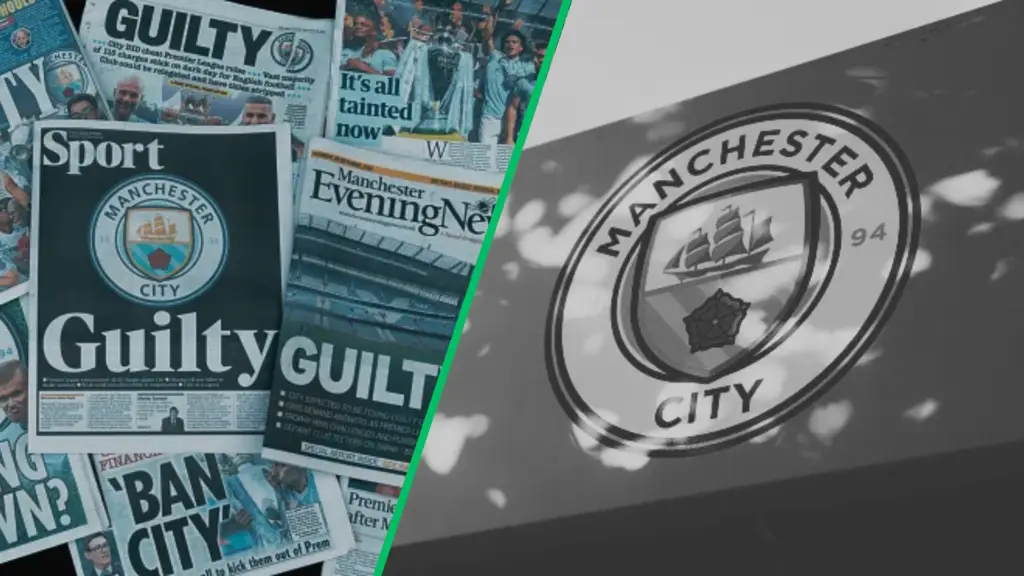
For three and a half years, “115 charges” was the punchline to every Manchester City argument. Rival fans chanted it, pundits danced around it, and most of us nodded along without really knowing what it meant.
That changed in the last week of September 2026. An independent commission found City guilty of 114 of the 115 charges, and on 1 October the club lodged its appeal. Suddenly the joke is the biggest disciplinary case English football has ever seen.
So let’s slow down and do this properly. No legal jargon, no tribal shouting. Just what City were accused of, how the process works, what the verdict actually said, and what could happen next.
How we got here
The story starts with a leak, not a league. In November 2018, German magazine Der Spiegel published a series of reports built on hacked internal City emails, alleging inflated sponsorship deals and backdated contracts. City dismissed the material as stolen and taken out of context.
The leaks triggered two separate investigations, one by UEFA and one by the Premier League. UEFA moved first. The Premier League took its time, then dropped its bombshell in February 2023.
Date | What happened |
|---|---|
Sep 2026 | Commission finds City guilty of 114 of 115 charges; City appeal on 1 Oct |
Sep–Dec 2024 | A 10-week private hearing in London |
6 Feb 2023 | Premier League announces 115 charges and refers the case to an independent commission |
Jul 2020 | CAS overturns the UEFA ban, citing evidence gaps and time limits |
Feb 2020 | UEFA bans City from the Champions League for two seasons |
Mar 2019 | UEFA and the Premier League open investigations |
Nov 2018 | Der Spiegel publishes the leaked emails |
Source: Wikipedia case summary
The case, step by step
From investigation to punishment. The appeal comes before any sanction is final.
- Investigation2019 to 2023
- ChargesFeb 2023
- HearingSep to Dec 2024
- VerdictSep 2026
- AppealLodged 1 Oct 2026We are here
- PunishmentNot set yet
The charges, in simple words
Forget the number for a second. The 115 charges boil down to five types of accusation, and they all orbit one core idea: City’s books didn’t tell the truth.
1. Dodgy accounts (54 charges). Every season, clubs must hand the league accurate financial information. The league said City’s numbers were wrong, mostly because sponsorship income was inflated.
Think of it like this. A sponsor signs a deal saying it will pay £60m. In reality it pays £10m, and the owner quietly tops up the other £50m. On paper it looks like a commercial windfall. In reality, it’s the owner’s own money wearing a sponsor’s shirt.
2. Hidden wages (14 charges). Clubs must declare everything they pay players and managers. The allegation was that some payments were routed off the books, so City’s wage bill looked smaller than it really was.
3. Breaking the Premier League’s spending rules (7 charges). The league’s Profit and Sustainability Rules cap how much money a club can lose. If your revenue is inflated and your costs are hidden, you can appear to pass that test when you’d actually fail it.
4. Breaking UEFA’s spending rules (5 charges). Same idea, but under UEFA’s Financial Fair Play regime, which the Premier League also required clubs to follow.
5. Not cooperating (35 charges). These cover 2018 to 2023, when the league says City failed to hand over documents and help the investigation properly.
So the first four groups are the alleged cheating. The fifth is the alleged stonewalling once someone came looking.
Why 115? The number explained
City weren’t accused of 115 different schemes. The big number comes from counting each rule, in each season, as a separate charge. One bad set of accounts breaks several rules at once, and the alleged conduct ran for nine seasons, from 2009-10 to 2017-18. Multiply those together and the total climbs fast.
Type of charge | Number | Verdict |
|---|---|---|
Inaccurate financial information | 54 | Guilty on all |
Inaccurate player and manager pay details | 14 | Guilty on all |
Premier League spending rules (PSR) | 7 | Guilty on all |
UEFA Financial Fair Play rules | 5 | Guilty on all |
Failure to cooperate (2018–2023) | 35 | Guilty on 34 |
Total | 115 | Guilty on 114 |
That’s why you’ll hear people say the “real” case is the 80 financial charges. The commission found City guilty on every one of them.
How the process works
This isn’t a criminal trial. Nobody is going to prison, there’s no jury, and it never went near a public courtroom. It’s a private disciplinary case run under the Premier League’s own rulebook, which every club signs up to.
Here’s the path, step by step:
- The league investigates. It gathers documents and builds its case. This took from 2019 to 2023.
- Charges go to an independent commission. Three legal experts, chosen by the chair of the league’s Judicial Panel, not by the league’s executives.
- A private hearing. Both sides argue their case. City’s ran from September to December 2024 in London.
- The verdict. The commission decides guilty or not guilty on each charge. That landed in September 2026.
- Sanctions. The same commission sets the punishment at a separate private hearing.
- Appeal. A brand-new three-person panel reviews the verdict. No new evidence is allowed; the argument is that the first panel got the law or the facts wrong.
Why did it take so long? Sheer scale. Nine seasons of accounts, mountains of documents, and two sides with some of the best-paid lawyers in Britain.
Hold on, didn’t City already win this once?
Sort of, and it’s why many City fans felt confident. In 2020, UEFA banned City from the Champions League for two years over inflated sponsorship. City appealed to the Court of Arbitration for Sport (CAS), which lifted the ban. CAS said most of the alleged breaches were either not proven or too old to punish under UEFA’s time limits. The fine was cut to €10m, for failing to cooperate.
The Premier League case is different in two big ways. Its rules don’t carry the same time limit, so it could look back to 2009. And this time there’s no route to CAS. City’s appeal stays inside the Premier League system, though British media report the club could still challenge the fairness of the process in England’s High Court.
What the verdict found, and City's response
The commission’s findings were about as damning as they come. According to the Premier League, City used “sham” sponsorship contracts: sponsors paid only part of the agreed fee, and the club’s owners, Abu Dhabi United Group (ADUG), secretly covered the rest.
It didn’t stop at sponsorship. The panel also found an owner-funded arrangement that made City’s running costs look lower than they were, and a circular deal involving a company called Fordham, which bought players’ image rights using ADUG money.
The headline figure: those schemes inflated revenue and cut reported costs by more than £900m across nine seasons. More than £830m of that was owner funding disguised as sponsorship. Had City reported honestly, the commission said, they would have broken the spending limits by a very substantial amount. League chief executive Richard Masters called it the most significant case in the competition’s history. (Al Jazeera)
City’s side of the story
City have denied wrongdoing from day one, and nothing has changed. The club said it was disappointed and surprised, called the findings unsafe, and insists it has irrefutable evidence on its side. Co-chairman Khaldoon Al Mubarak told fans that “nothing has changed”.
City lodged a “comprehensive appeal” at 7pm on Thursday 1 October, a day before the deadline, arguing the decision contains material errors of law, principle and fact. ESPN’s sources say part of the appeal will argue the money came from the Abu Dhabi government rather than ADUG. (ESPN)
Worth remembering: City have fought the league elsewhere too. In 2024 the club challenged the Premier League’s rules on deals with owner-linked companies (known as APT rules). That dispute was later settled, with City accepting the current rules as valid and binding.
What punishment could City face?
Nobody knows yet, because the sanction hasn’t been set. Under Rule W64 of the Premier League handbook, the commission can fine a club, deduct points, or expel it from the league. A catch-all clause letting it make any other order it sees fit means stripping titles is possible in theory.
There’s no fixed tariff, so the best guide is what happened to others:
Club | Breach | Punishment |
|---|---|---|
Everton (2023-24) | Overspending in one three-year period | 10 points, cut to 6 on appeal |
Nottingham Forest (2023-24) | Overspending | 4 points |
Man City (2020, UEFA) | Inflated sponsorship, non-cooperation | 2-year European ban, overturned; €10m fine |
City’s case covers nine seasons, not one, plus years of non-cooperation. Football finance expert Kieran Maguire has suggested punishments should be roughly ten times what Everton and Forest received, which points to something like 40 to 60 points. For context, a 40-point hit would have dropped City to 18th last season.
The timing headache
This is the part that could cause chaos. If the punishment lands before the appeal is heard, City could be relegated and then cleared. If it waits until after, City keep their points this season, potentially costing a rival its Premier League place or a European spot.
And City are top of the table right now, after a record £460m summer spend that included Enzo Fernández.
Why this matters beyond City
This case was always bigger than one club. It’s a test of whether the Premier League can actually enforce its own financial rules against its richest, most powerful member.
The ripples are already spreading. Other clubs are reportedly preparing legal action for compensation, and there’s precedent: this year Everton were ordered to pay Burnley more than £35m after Burnley argued they would have stayed up in 2021-22 had Everton been punished on time. Imagine that logic applied across nine seasons of title races, top-four finishes and relegation battles.
Will trophies change hands? Probably not. Tony Pulis, whose Stoke lost the 2011 FA Cup final to City, told the BBC he doesn’t expect them to, but still feels cheated. Money is a far more likely remedy than silverware.
The bottom line
Strip away the noise and the case is simple. The Premier League said City dressed up owner money as sponsorship income to dodge spending limits, then dragged their feet when investigated. An independent commission agreed on 114 of 115 counts. City say that’s flat wrong and are appealing.
Until the appeal is decided and a sanction is set, the final chapter isn’t written. But for the first time since 2023, “115” is no longer just an accusation. It’s a verdict.