
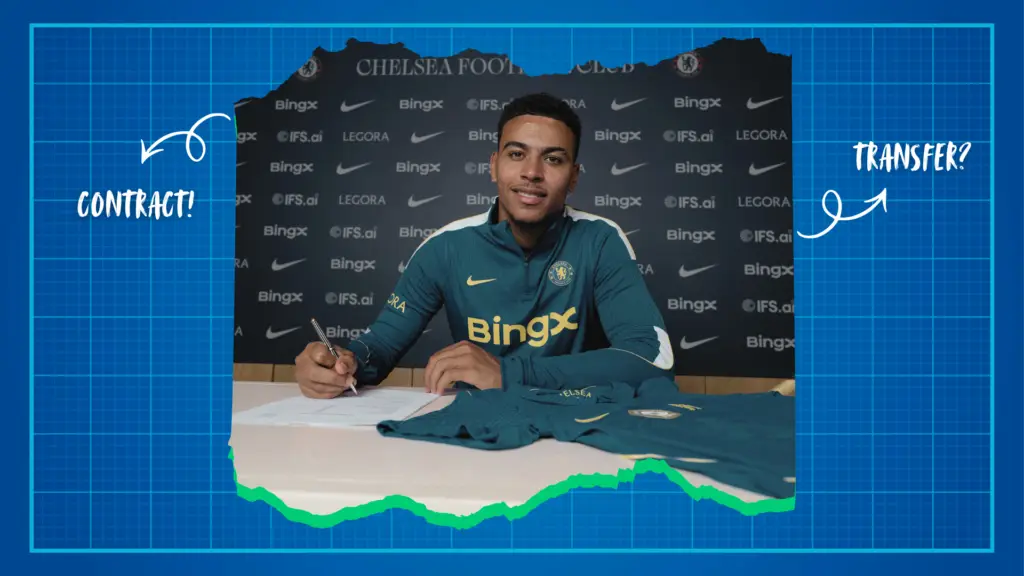
Most fans experience a transfer as a single moment. A graphic appears on a club’s social media, a player holds up a shirt, and a fee gets reported. What almost nobody sees is the year of groundwork, negotiation and accounting strategy sitting underneath that graphic. Chelsea’s British record signing of Morgan Rogers from Aston Villa is a good case to break that process open, because every stage of it is visible if you know where to look.
It starts long before anyone makes an offer
Clubs don’t wake up one morning and decide to spend £117 million. Rogers had been on Chelsea’s radar for well over a year. He joined Villa from Middlesbrough in February 2024 for a modest £8 million and quickly became one of the standout performers in the Premier League, scoring 10 goals and adding seven assists in 37 league appearances last season (Sky Sports). Performances like that get logged by every big club’s scouting department, and by the time a bid actually lands the buying club has usually watched a player across dozens of matches, cross-checked him against internal models, and decided he fills a specific tactical need.
For Chelsea that need was obvious. Xabi Alonso wanted attackers who could operate centrally and combine quickly, and Rogers, an England international fresh off the World Cup, matched the profile.
The selling club's situation matters as much as the player
Aston Villa didn’t want to sell Rogers. They saw him as a building block.
What forced the conversation was a rule change that most coverage still hasn’t caught up with, and it’s worth slowing down on, because it quietly explains everything else in this deal.
Until this summer, English clubs lived under Profit and Sustainability Rules. PSR was essentially a limit on how deep into the red you could go: lose more than £105 million across any rolling three year period and you got punished, as Everton and Nottingham Forest both discovered. Clubs voted in November 2025 to scrap that system from the start of the 2026/27 season and replace it with the Squad Cost Ratio, which is the rule this transfer actually happened under (Premier League).
SCR ignores your losses entirely. It asks one question instead: what share of your football income are you spending on the squad?
The answer has to be 85 per cent or less. Squad spending means wages, agents’ fees, and the annual accounting cost of your transfers. So a club pulling in £400 million a year from football is allowed to put roughly £340 million of it into the playing side. There is a cushion on top, an extra 30 per cent that can be spread across several years, but dipping into it costs you a levy.
Here is why that matters for Villa. Under SCR, profit from selling players counts towards your income, so a big sale doesn’t just keep you out of trouble, it raises your own ceiling. Villa paid £8 million for Rogers in early 2024 and have been writing that fee down ever since, so on their books he is worth only a few million today. Selling him for £117 million converts something like £113 million of that into pure profit, and that profit lifts the amount Villa are permitted to spend on everybody else in the squad.
That is the churn analysts keep describing, where clubs sell their best players because the accounting requires it rather than because they want to (The Independent). The new rules don’t slow it down. If anything they speed it up, because the benefit now shows up in the same season rather than three years later.
Negotiating the fee is only half the deal
Once a club agrees to sell, negotiation runs on two separate tracks that fans tend to lump together.
The first is club to club. Chelsea and Villa settled on a flat £117 million with no add-ons, meaning the entire fee is guaranteed rather than tied to appearances, trophies or caps (Roundtable). Add-on structures exist because they let a buyer spread risk, so paying the whole thing upfront signals confidence and also strengthens Chelsea’s hand at the table, since sellers generally prefer certainty to conditional payments. The number carries its own weight. It beats Chelsea’s previous club record of £115 million for Moises Caicedo in 2023, and it makes Rogers the most expensive British player in history, edging past the £116 million Manchester City paid for Elliot Anderson only weeks earlier in the same window (Sky Sports).
The second track is personal terms, negotiated separately between the player’s representatives and the buying club, covering wages, contract length, image rights and bonuses. Rogers signed a seven year deal running through 2033 (Al Jazeera). A manager’s personal involvement often settles these conversations. Alonso called Rogers directly to explain how he saw him fitting in, and Rogers later said those calls mattered in understanding how the manager wanted to play (Roundtable). Elite transfers are rarely closed on money alone.
Why the length of the contract is the real story
For years, the standard explanation of a long Chelsea contract was amortisation, which sounds technical and really isn’t.
When a club buys a player, it doesn’t record the whole fee as a cost in the year it pays. It treats him a bit like a delivery van: something the business will use for years, so the cost gets spread across those years rather than dumped into one set of accounts. Buy a £50 million player on a five year contract and the books show £10 million a year for five years, not £50 million all at once.
Which creates an obvious temptation. Stretch the contract, shrink the yearly number. Chelsea worked this out faster than anyone and handed Mykhailo Mudryk an eight and a half year deal in January 2023. His £88.5 million fee, divided across all those seasons, landed in the accounts at roughly £10 million a year. One of the most expensive signings in the club’s history was costing them about the same annually as a decent squad player.
Everyone else noticed. UEFA capped amortisation at five years in June 2023, and Premier League clubs voted the same cap through that December, with Chelsea among the fifteen who voted in favour (Sky Sports). Clubs can still hand out contracts of any length they like. The fee simply stops being spreadable after year five.
So the Mudryk trick no longer works, and the arithmetic on Rogers isn’t £16.7 million a year across seven seasons. Chelsea have to fit £117 million into five years, which comes to roughly £23.4 million a season through 2031.
Chelsea's books, 2026–2033
One fee. Two very different sets of accounts.
£117 million doesn't hit the accounts in one go. It gets spread across the contract. How far it can be spread is the whole argument.
£117m either way. The cap doesn't change what Chelsea paid, only how quickly they have to book it.
Under the five-year cap, the fee is fully written off by 2031. Rogers plays the last two years of his contract costing the accounts nothing but his wages.
Fee and contract length per Sky Sports and Al Jazeera. Five-year amortisation cap adopted by UEFA in June 2023 and by Premier League clubs that December.
In 2032 and 2033, the final two years of his contract, the fee is already fully written off and Rogers costs the accounts nothing but his wages.
That makes those seven years a very different decision than they would have been in 2023. The extra two years buy no accounting advantage whatsoever, so what they buy is control. A player tied down until 2033 can’t run his contract down, can’t leave on the cheap, and can only be sold when Chelsea decide rather than when the calendar decides for them. Remember what SCR does with sale profits, too. If Rogers goes in 2030 for £90 million, almost all of it lands as profit, and that profit expands what Chelsea are allowed to spend on his replacement. The long contract is there to protect what Chelsea can eventually get back, not to disguise what they paid.
The reaction shows the real tension in the deal
Not everyone is convinced this was smart business on footballing grounds. Paul Merson argued the move made little sense given Chelsea already have Cole Palmer occupying a similar attacking role, calling the fee “crazy money” and questioning where both players would actually fit on the pitch (Sky Sports). It’s a fair objection, and no amount of financial engineering resolves it. A club can structure a fee immaculately on paper and still hand its manager a selection problem every weekend.
My verdict
The numbers hold up better than the football does. £23.4 million a year is absorbable against Chelsea’s revenue base, and given how scarce homegrown attacking talent has become under current squad regulations, paying a premium for a 23-year-old England international with resale value is defensible business. Chelsea aren’t only buying a player here, they’re buying an asset they can develop, play, and sell again around 2030 at a price that, under the new rules, directly funds whatever comes next.
Where I side with the sceptics is on fit. Rogers and Palmer want the same grass, and £117 million brings a kind of pressure that has nothing to do with football and everything to do with what people expect when they hear the number.
Though I think Merson is describing a positional clash when the real one is stylistic, and that distinction is what decides whether this works. Palmer is a right-footed arriving player. He wants the ball in the right half-space with the game slowed down, and his best work happens in the final twenty yards of a settled attack. Rogers is left-footed and does his damage travelling, collecting it around halfway with his head up and eating forty yards before anyone gets close enough to matter. Those are different jobs. So the question isn’t whether both can be on the pitch together, it’s whether Alonso’s Chelsea will generate enough transition moments to use the second one properly, because a side built to dominate possession asks its attackers to receive in tight space rather than run into open grass. Buy a carrier and then build a system with nothing to carry into, and you have spent £117 million on a player operating at seventy per cent of himself.
History gives mixed signals. The fees for Declan Rice and Caicedo stopped being mentioned once the players delivered. Mudryk’s never stopped being mentioned, because he didn’t. Rogers will land in one of those two categories inside about eighteen months, and the price tag is what decides which conversation he gets.
The comparison I keep returning to isn’t Mudryk, though. It’s Jack Grealish. Another Villa talisman, another British record, another move to a manager who wanted him doing something narrower than the thing that made him expensive in the first place. Grealish’s years at City weren’t a failure by any reasonable measure, but the £100 million meant every disciplined, unspectacular, positionally correct afternoon got filed as underachievement. That is the actual risk with Rogers, and it has nothing to do with his ability. If Alonso asks him to hold width, protect a full-back and pick his moments, he might do all of it excellently and still spend three years being told he isn’t worth the money.
The bigger takeaway for anyone following football business is this. Watch contract length as closely as you watch the fee, but read it as a statement about when a club intends to sell rather than how it intends to pay.