There is a version of this story that begins with a press conference, but I prefer to begin with a silence.
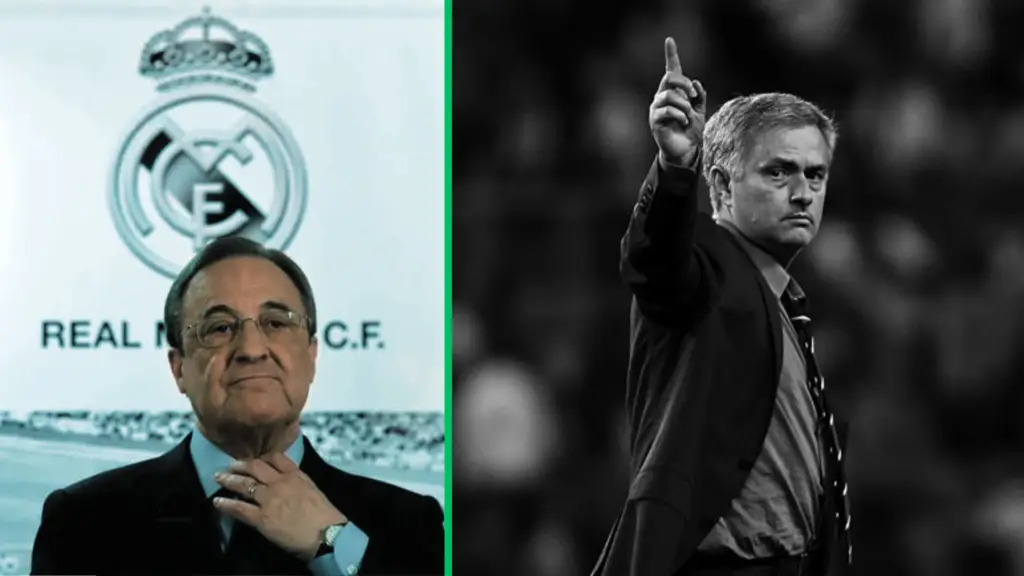
Bernabéu, June 2026. Florentino Pérez has just won a presidential election he never should have had to fight, and somewhere in Lisbon, a phone rings. The man on the other end has heard this call before, thirteen years before to be exact, and he knows, better than anyone alive, what it costs to pick it up. He picks it up anyway.
José Mourinho does not so much return to football clubs as reoccupy them. When he came to Madrid in 2010, he didn’t arrive to coach a team. He arrived to dismantle an era. And sixteen years later, greyer at the temples and carrying the quiet weight of every club he has loved and left, he is doing it again, stepping back through the doors of the Santiago Bernabéu on a two-year deal, brought in by a president who built his entire re-election campaign around a short video clip of Mourinho simply saying “Yes.” That single word, broadcast on Florentino Pérez’s social media with the tagline “So MOUch history to be made,” was enough to send the Spanish football world into a spin. It is, when you think about it, the most Mourinho thing imaginable. One word. Maximum impact. Not a single unnecessary syllable.
To understand why Madrid called him back, you first have to understand what the club looked like the first time he walked through those doors, and why it felt, to many people, like the end of the world.
2010: Breaking The Glass
By the summer of 2010, Real Madrid had become a club suffocating on its own reputation. For years they had chased the “Galácticos” dream, the idea that if you simply bought the most famous, most glamorous players on earth, trophies would follow as a matter of logic. They didn’t. The football was often dazzling but it had no backbone, no ruthlessness, no plan for the moments when glamour alone wasn’t enough. Their manager at the time, Manuel Pellegrini, had won 96 points in the Spanish league, a staggering haul by any normal measure, and still finished second. For six straight seasons, Madrid had been knocked out of the Champions League, Europe’s biggest club competition, in the last sixteen. Not the semi-finals. Not the final. The last sixteen. For a club of Madrid’s size and ambition, it was quietly humiliating. Meanwhile, thirty miles down the road, Pep Guardiola‘s Barcelona were putting on the greatest show in modern football history, fluid, suffocating, unstoppable, and had just beaten Madrid 5-0 at their own ground. The whole of European football was watching Barcelona and thinking: this is what the game should look like. Madrid were watching Barcelona and thinking: we have no idea how to stop this.
Enter Mourinho. Not as a healer, but as a surgeon with a blowtorch.
His first moves were ruthless and deliberate. He cleared out the players who didn’t fit his vision. Raúl, Madrid’s all-time leading scorer and the symbolic heart of the club for over a decade, was shipped out to Schalke in Germany. Other familiar faces followed. In their place came players chosen not for their star power but for what they could actually do: Mesut Özil, the German playmaker with radar-like vision; Ángel Di María, a tireless, lightning-quick Argentine winger; Sami Khedira, a German midfielder built like a wall and twice as hard to move. These weren’t signings designed to sell shirts. They were tools designed to win football matches in a very specific way.
And that way was this: sit deep, defend as a tight, disciplined unit, smother whatever the opponent tried to do, and then, the moment the ball was won, attack at terrifying speed before the other team had time to reorganise. Simple on paper. Brutally effective in practice. In front of goal, Mourinho had Cristiano Ronaldo, still in the early stages of becoming the most prolific scorer the game has ever seen, given a clear instruction: get in behind, get on the end of it, and score. Ronaldo, it turned out, was very good at this.
The results were extraordinary. In their second season under Mourinho, 2011-12, Madrid broke virtually every record in Spanish football history: 100 points from 38 games, 121 goals scored, 32 wins. No team had ever done it before. It wasn’t always pretty. There were nights when Madrid defended deep and played on the counter-attack and were accused of being boring, cowardly, anti-football. Mourinho did not care even slightly. “I prefer to win 1-0 playing badly,” he once said, “than to lose 5-4 playing well.” For a club that had spent years losing beautifully, it felt like a revelation.
But it was in the spaces between the matches, in the press rooms, the tunnel after games, the slow-burning soap opera of the dressing room, that Mourinho truly made his mark.
He understood, at an almost instinctive level, that elite sport is as much a psychological battle as a physical one. The series of matches between Madrid and Barcelona in the spring of 2011, four games across four different competitions in the space of seventeen days, became less a series of football matches and more a kind of extended psychological warfare. Mourinho used every tool available to him. He complained about referees, loudly and constantly, creating in his squad the sense that the world was lined up against them. He named players who were injured or suspended in his starting lineup just to mess with Guardiola’s preparation. He poked, literally physically poked, Barcelona’s assistant manager Tito Vilanova in the eye during a post-match scuffle, a moment that horrified football’s polite society and delighted his own players in roughly equal measure. Whether you found all of this inspiring or repellent probably depends on how you feel about football more broadly. But the point is that Mourinho was always working, always thinking, always trying to find an edge even when the game itself wasn’t being played.
The 2011–12 season · La Liga records
Mourinho's win rate across major clubs
Win % = wins ÷ total competitive matches. Data covers all competitions at each club.
The Cracks Beneath the Crown
And yet, underneath all the victories and the noise, there were cracks.
Iker Casillas, Madrid’s legendary goalkeeper and captain, the man who had spent his entire career at the club, found himself quietly dropped from the starting lineup, a decision that split the dressing room down the middle and left scars that never fully healed. Sergio Ramos, the passionate, combative defender who would go on to captain the club for years afterwards, had his own conflicts with Mourinho. The training ground at times felt less like a team preparing to win together and more like two armed camps glaring at each other across a corridor. Mourinho later admitted that Madrid was where he learned the hardest lessons of his career, not about football but about human beings. About how far you can push a group of people before they push back. About how you can be winning everything and losing everything at the same time.
The Champions League, the trophy that Madrid obsessed over above all others, kept slipping away. Three consecutive semi-finals. Three exits. Always close. Never quite there. Mourinho pointed out, with characteristic bluntness, that the eighteen managers before him had reached just five semi-finals combined. His record of three in three years was extraordinary by any historical measure. It didn’t matter. At Real Madrid, the Champions League isn’t a trophy. It’s an expectation. And Mourinho left in 2013 without meeting it, returning to Chelsea and then drifting, brilliantly and chaotically, through Manchester United, Tottenham, Roma, Fenerbahçe, and finally Benfica, where he had spent last season delivering an unbeaten league campaign and quietly rebuilding his reputation as a manager who could still shape a football club in his own image.
2026: The Wounded King, Wiser
Which brings us back to that phone call. And to the question nobody in Madrid has quite managed to answer: why now?
The honest answer is that Madrid, in 2026, are a club that has stopped being afraid of losing. Two years without a major trophy. A dressing room described by multiple sources as a place of tension and unease, shaken by injury controversies and off-field drama. A managerial carousel, Carlo Ancelotti gone, then Xabi Alonso, then Álvaro Arbeloa, all in barely a season, that speaks not of careful planning but of panic. Pérez didn’t campaign on Mourinho because he had some sophisticated tactical vision for the future of the club. He campaigned on Mourinho because he knows, from hard experience, that there is one thing this particular manager does better than anyone else alive: he makes a comfortable dressing room deeply, uncomfortably afraid of losing its comfort.
The Mourinho who returns is not quite the same one who left, and it would be too easy, too lazy even, to treat this as a simple replay of 2010. He is sixty-three now. The explosions are more controlled. The press conferences are sharper and shorter. At Benfica, observers noticed he was more protective of his players in public, slower to throw individuals under the bus when results went badly. The fire is still there, and it will always be there, it is simply who he is, but the man holding the fire has learned, in the years since Madrid, some things about which battles are worth fighting and which ones just burn you.
The challenge in 2026 is also different in a way that matters. In 2010, Mourinho had a clearly defined enemy: Barcelona, Guardiola, the idea that beautiful possession football was the only correct way to play. That enemy gave his squad a shared identity, a focus for everything they were working towards. There is no Guardiola across the city this time. The enemy is softer, harder to grab: complacency, fragmented leadership, talent that hasn’t been forged into anything yet. His task now is not to overthrow an empire. It is to give a group of wealthy, talented, slightly comfortable footballers something to be genuinely angry about.
Whether that is possible, whether the same spell can work twice on the same club, is the question Madrid will be living inside for the next two years. Football has a short memory for methods and a long memory for results, and Mourinho’s results at Madrid, stripped of all the noise, were remarkable. The records stood for a decade. The mentality he installed, many insiders argued, was the emotional foundation on which Ancelotti’s gentler, more harmonious teams later built their Champions League dominance.
The Mirror
But here is the thing about Mourinho that his fiercest critics and his most devoted supporters tend to agree on: he is not built for comfortable middle ground. He arrives, he disrupts, he wins things or he burns things or, in his most dramatic seasons, he manages to do both simultaneously. It rarely ends quietly. It always ends having meant something.
Some clubs need a manager who makes them play better football. Real Madrid, in the summer of 2026, needed a manager who could make them care again. Florentino Pérez, for all his many contradictions, understood one thing clearly when he made that call to Lisbon: there is only one person in the world whose voice, even after thirteen years, still makes that dressing room sit up straight. The Special One didn’t come back to Madrid to be loved. He came back, as he always does, to make a club look in the mirror. The Bernabéu, for better or worse, is about to find out what stares back.